











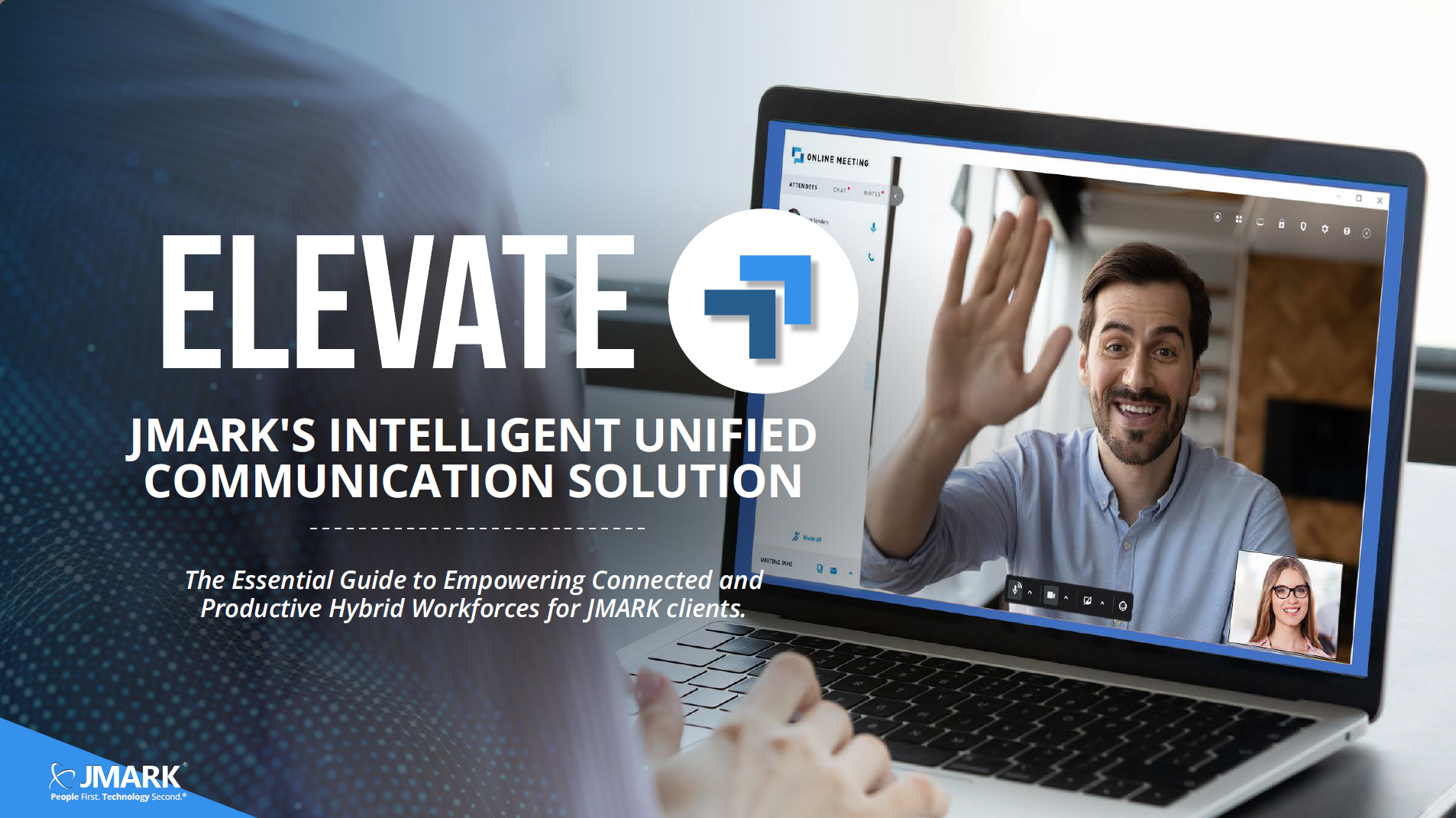
Elevate - JMARK's Intelligent Unified Communication Solution
Introduction No matter where you work, consistent and reliable communication is essential for any business. Your communication pathways, platforms,...
IT built for regulatory scrutiny and cyber risk backed by core system expertise.
HealthcareSecure, always-available clinical systems for patient care continuity.
Education & Public ServicesReliable infrastructure for always-on learning, government services, and mission-driven organizations.
24/7 multi-property uptime for complex hospitality environments.
Professional ServicesProtect billable productivity and client data—for law firms, engineering & consulting, architecture, and accounting.
ManufacturingOperational continuity for production systems and complex plant networks.
The Strategic IT Budgeting Guide
Access Guide ->
We are the stewards for the long-term success of our customers and employees.
Explore our culture -->
Meet the team -->
The #1 Best Place to Work in Southwest Missouri. We put people first.
Working at JMARK -->
Open Positions -->
Business leaders now field specific pitches about AI-enabled forecasting in their ERP systems, virtual assistants within their ticketing platforms, and automated document review in legal or compliance workflows. Boards are asking when these ideas will translate into measurable impact on cost, risk, or growth. Large customers are asking how their data will be handled when AI is involved and whether the organization has a defined approach, rather than a collection of experiments.
The question we must now answer has shifted from whether AI will influence your business to how prepared your organization is to use it responsibly.
In our work with organizations across regulated and non-regulated industries, we see similar patterns. This guide focuses on the conditions that allow AI to move from isolated pilots to dependable projects that support growth, without creating doubts about data accuracy or security:
Our role is to help you examine these foundations with clear language and practical structures. The recommendations in this guide are designed for leaders who need to balance innovation with risk and who care equally about operational resilience as they do about new capabilities.
Most organizations approach AI through a list of use cases, exploring where it might save time, reduce manual work, or improve a specific workflow. While that exploration is useful, it can obscure a larger focus—because AI is most valuable when it improves three things:
It’s because these outcomes depend less on the specific model and more on the environment around it. Ultimately, clean data, clear responsibilities, stable systems, and informed staff have a greater impact on determining AI success than any single tool.
In conversations with executives across banking, manufacturing, healthcare, hospitality, and professional services, a few common objectives appear repeatedly:
Reduce the hours employees spend re-entering the same data into their CRM, ERP, and spreadsheets so that relationship managers, plant supervisors, and frontline staff can spend more time with clients and teams.
Gain clearer visibility into branch, plant, or department performance through a single, agreed-upon dashboard instead of multiple reports that show different numbers for the same metric.
Improve the reliability of client and customer experiences, for example, by keeping response times in the support queue, call center, and branch lobby within defined targets across locations.
Avoid surprises such as audit findings related to dormant administrator accounts, third-party risk questionnaires that cannot be answered with confidence, or client questions about how their data was used in an AI tool that the organization did not formally approve.
AI can support these objectives—revealing trends, standardizing outputs, and augmenting human judgment, but it does this effectively only when the underlying inputs and controls are sound.
AI readiness can be defined as the degree to which your organization can adopt and scale AI in a way that aligns with business goals, risk appetite, and regulatory obligations. Rather than looking at readiness through a single project, we’ve found more success among our clients when we view it as a cross-functional state that reflects how well three domains work together:
Data is identified, structured, and governed in a way that allows AI systems to access what they need without relying on ad hoc workarounds.
Identity, access, monitoring, and incident response practices extend to AI tools and vendors so that new tools do not bypass existing controls.
Employees understand how AI will be used in the organization, what data is appropriate to use, and what oversight is required.
When these domains are fragmented, AI projects often produce dashboards that no one fully trusts, conflicting recommendations from different tools, and manual workarounds that increase security exposure. When data, security, and human preparedness align, leadership can approve new AI pilots, connect them to core systems, and scale successful ones across branches or plants with a clearer understanding of the associated risks.
Leaders often sense gaps before they can fully describe them. Common signals include:
When these domains are fragmented, AI projects often produce dashboards that no one fully trusts, conflicting recommendations from different tools, and manual workarounds that increase security exposure. When data, security, and human preparedness align, leadership can approve new AI pilots, connect them to core systems, and scale successful ones across branches or plants with a clearer understanding of the associated risks.
AI depends on the quality of the information it receives. When customer records are missing contact details, inventory systems use different product codes for the same item, or transaction histories live partly in a database and partly in unmanaged spreadsheets, AI will reproduce those gaps and sometimes surface confident recommendations based on them.
In practice, improving data health typically involves agreeing on a single source of truth for core data, standardizing how fields are entered, and cleaning up outdated records, rather than adding more analytics tools.
It can be helpful to view your data health across four dimensions: Visibility, Validation, Protection, and Governance.
Visibility is the ability to answer a simple question with confidence: Where does our important data live? Practical steps include:
Without this map, teams often begin AI pilots assuming that all customer data lives in the CRM, that key reports draw from the same source system, or that only a small set of applications holds regulated data, and those assumptions start to break down as soon as security, audit, or operations teams ask detailed questions about lineage and access.
Validation determines whether the data in specific reports and systems is reliable enough to support decisions, such as branch performance reviews, pricing changes, or staffing plans. Useful practices include:
Data validation is less about catching every possible error and more about confirming that, for example, customer records include complete contact details, dates, and identifiers follow a consistent format, and status fields are used the same way across teams so managers and frontline staff can trust the numbers in front of them without rerunning reports or asking for manual confirmation each time.
Once you understand where data lives and how reliable it is, you can align protection with sensitivity in specific systems and workflows. Key actions include:
This approach helps avoid two common extremes: one is over-restriction, which blocks pilot projects because employees cannot use any existing data. The other is permissive access that allows unapproved tools to read file shares, email, or ticketing data containing sensitive information without a clear record of who granted that access or why.
Governance clarifies who, by name or role, is responsible for the decisions that shape how data is used in specific systems and reports. Elements of pragmatic governance include:
Governance simply needs to be concrete enough that analysts, developers, and managers know whether to speak with a finance data owner, an operations lead, or a security representative when AI projects touch important data.
Every AI tool becomes part of your broader technology ecosystem once it touches identities, data stores, workflows, and vendors. Secure integration requires you to add AI tools to your directory services, business applications, networks, and vendor relationships in a way that respects existing identity, access, monitoring, and incident response controls rather than creating new paths around them.
A useful way to structure this work is across four layers: Identity, Data Access, Model Governance, and Channel and Device Access.
Identity addresses which specific users and groups can sign in to AI tools, what level of access they receive, and from which locations or devices that access is allowed. Practical measures include:
Data access defines which specific databases, file repositories, and applications AI systems can read from, what fields they can return, and whether they are allowed to store any of that information. Key considerations include:
These steps reduce the likelihood that AI will draw from sources or fields that leadership did not intend to expose, such as archived mail, legacy file shares, or regulated data that was connected during an early proof of concept and never fully reviewed.
Model governance is the oversight of how specific AI models are chosen for tasks such as chat assistance, forecasting, or document review, how these models are configured for your environment, and when they are updated or replaced. For many organizations, this includes:
Model governance ties AI behavior back to accountable owners, such as a data science lead, system owner, or risk manager, rather than treating it as an opaque feature buried inside a product.
Channel and device considerations focus on where and how users interact with AI, like whether they are on a managed laptop in the office, a personally owned tablet at home, or a mobile device connected over public Wi-Fi. Relevant practices include:
When all four layers are addressed together, AI access through web portals, desktop applications, and mobile clients becomes part of a coherent security ecosystem, rather than an exception that operates outside normal controls.
Before committing to any AI vendor, it can be helpful to refer to a structured set of questions for evaluation, such as the seven below.
Technology alone does not determine how AI is used. The way a manager decides whether to paste a client list into a drafting tool, how a supervisor asks staff to use a chat assistant for ticket responses, and whether an analyst uploads raw spreadsheets into an external model all shape outcomes. Education and policy provide the framework for these daily choices.
An effective approach in mid-sized organizations usually combines three elements:
Awareness begins with transparency about specific tools, workflows, and data sources. Employees benefit from seeing which AI tools are approved, where those tools show up in their everyday systems, and what types of data they are allowed to use, rather than only hearing high-level statements about AI in general. They should understand:
This level of specificity reduces the speculation about what is and what is not allowed and helps staff see AI as part of the normal tools they already use at their desks, in branches, or on the floor, rather than a separate initiative that only a few teams can access.
General training is helpful, but most employees change their behavior when they see examples that match their own tools and tasks. Role-based guidelines give employees clear patterns to follow and adapt, such as what they can safely draft or summarize with AI, which systems they should work in, and which information should never leave core applications. Here are some examples:
HR may use AI inside an approved HRIS or office suite to refine job descriptions for a new branch manager role, while following a clear rule that resumes, interview notes, and performance records stay inside systems such as Paycom, Workday, or the applicant tracking system and are never pasted into public drafting tools.
Finance may use AI to summarize monthly variance reports or propose a first draft commentary for the board packet, while keeping raw trial balances, general ledger exports, and bank statements within the ERP and financial reporting tools that already have access controls and audit logs.
Operations may use AI to draft standard operating procedures by drawing on maintenance logs from a CMMS or ticket summaries from an internal system, while leaving out client names, contact details, or resident notes that would identify a specific organization or individual in an external model.
Accountability, within the context of responsible AI integration, means spelling out, in writing, which behaviors are expected when staff use AI, what is out of bounds, and what will happen if those expectations are repeatedly ignored.
Core components of an AI usage policy often include:
When policies are specific, implemented through existing governance forums like risk committees or IT steering groups, and reinforced by leadership behavior during daily decisions, they create room for teams to experiment with AI inside clear boundaries rather than blocking innovation outright.
Organizations often structure their AI policy into a short set of ground rules. Here are some that may be helpful to get started:
Although it may seem that online discussions stress the need for everyone to become an expert, leaders do not need to become AI engineers. Instead, they should decide which AI initiatives are included in the strategic plan, how AI-enabled tools are discussed in town halls and team meetings, and how AI-related risks are integrated into existing risk registers, board materials, and control frameworks. A helpful leadership stance to adopt involves these four recurring actions: Anticipate, Align, Audit, and Adapt.
Monitor how AI is being applied in your industry, among peers, and within your own organization by looking at specific examples, such as how competitors use AI to:
Ask vendors, industry groups, and your own teams for concrete use cases that have been running for at least several months and can show changes in error rates, cycle times, or customer satisfaction, rather than one-time pilots highlighted in press releases.
Identify areas where quality, cycle time, or customer experience are constrained by data or process issues in your own environment. For example, look for recurring delays in onboarding new customers, long turnaround times on underwriting or change approvals, repeated complaints about support response times, or frequent manual reconciliation between systems. These are often areas where AI, paired with stronger data, security, and process foundations, can contribute in a measurable way.
Ensure that AI projects tie directly to specific business objectives and metrics. For example, define whether a project is expected to reduce new customer onboarding time from several days to a defined target, improve forecast accuracy for a particular product line or region by a measurable percentage, or lower the cost per ticket in the service desk by reducing rework and handoffs.
Align AI work with your existing risk frameworks and regulatory context by mapping each initiative to entries in the enterprise risk register, applicable regulations such as HIPAA, FFIEC, or PCI where relevant, and existing control owners. This alignment keeps AI from becoming an isolated agenda item and ensures that risk, compliance, and audit teams understand how AI-related changes fit into reviews they already perform.
Regularly review where AI is in use, which specific applications and workflows it is embedded in, what data sources and fields it can access, and which reports, approvals, or client-facing decisions rely on its outputs.
Auditing AI in this way is similar to periodic reviews of outsourcing, cloud usage, or other structural changes that shift how core processes and sensitive data are handled across vendors, platforms, and internal teams.
Adaptation may include retiring AI features in marketing, finance, or operations that never moved past a proof of concept, tightening AI access in document management or case management systems after an internal review, or shifting from generic AI success stories to specific metrics such as:
Leaders play a central role by deciding when to scale up pilots in areas such as internal audit sampling, contract and policy review, or training development. Additionally, asking for these operational metrics in quarterly reviews, sponsoring updates to AI-related policies in forums such as the risk committee or IT steering group, and explaining in town halls, manager meetings, and board materials how each adjustment supports the organization’s mission, values, and obligations to customers, residents, or patients, is a clear way to keep the change process as smooth as possible.
Over the next several years, many organizations can expect developments similar to those listed below:
Preparing for these shifts now by building an inventory of AI uses, strengthening data and security disciplines, and clarifying accountability positions your organization to respond with a measured plan rather than urgent case-by-case reactions.
Now that you have the steps needed to responsibly integrate AI into your organization, it’s time to put them into action.
The most important area of focus for you now is your data health. Review key systems like ERP, CRM, EMR, and ticketing platforms to verify your data is accurate.
If you’re not sure where to start, schedule a strategy call with one of our team members. We’d be happy to help walk you through what has worked well for us and our clients.
Our role is to provide a clear outside view, connect AI initiatives to your existing technology and security strategies, and help leaders move from general interest in AI to a sequence of informed decisions that fit your risk appetite and resource limitations.
Whether you work with JMARK or another advisor, the central recommendation of this guide is consistent. Treat AI as an extension of your data, security, and people strategies, not as a separate experiment. When you do, AI becomes one more way your organization serves its customers, supports its employees, and sustains its growth.
Introduction No matter where you work, consistent and reliable communication is essential for any business. Your communication pathways, platforms,...
Introduction Every leader has that moment. Maybe it’s the second hour into an audit or the third “urgent” email from IT this week. You look at the...
Executive Perspective Business leaders now field specific pitches about AI-enabled forecasting in their ERP systems, virtual assistants within their...