





















Managed Intelligence Services
When decisions are faster, everything moves forward.
Secure intelligence for your organization
For growing and mid-market organizations that need their data and workflows secured, connected, and automated.
AI ecosystem integration: Integrates AI models into one operational environment rather than forcing a single model to solve every task.
Unified AI operating layer: Gives teams one environment for interacting with multiple AI systems instead of managing each model independently.
LLM orchestration layer: Automatically routes prompts to the optimal model (OpenAI, Anthropic, local models, etc.) based on task requirements.
Task-specific model selection: Uses different models for coding, reasoning, research, or document generation.
Parallel agent workflows: Specialized agents collaborate across models to execute complex research, analysis, and drafting tasks.
Cost-optimized model selection: Routes tasks to the most efficient model—balancing cost, speed, and reasoning capability.
Private inference environment: AI processing occurs inside JMARK infrastructure rather than public consumer AI tools.
Client-isolated environments: Each organization operates its own AI instance and data environment.
Context protection: Business context and prompts are never exposed directly to public models.
Encrypted data architecture: Organizational data remains encrypted at rest and cannot be used to train external models.
AI governance & monitoring: Track usage, audit prompts, and enforce organizational AI policies.
Human-in-the-loop validation: AI outputs are reviewed and validated before execution in business workflows.
Connected data foundation: Pulls data from your core systems into one unified environment—so AI can answer what matters.
Core system intelligence: Connect AI directly to operational systems such as ERP, banking cores, CRM, finance, and HR platforms.
Normalized data model: Converts fragmented system data into a unified business intelligence layer.
Organizational memory: AI learns from documents, conversations, workflows, and internal knowledge bases.
Digital workforce agents: AI agents execute research, reporting, forecasting, and operational analysis.
Business intelligence & forecasting: Ask complex operational questions across multiple systems instantly.
Strategic decision support: AI analyzes trends, detects anomalies, and produces actionable insights.
Industry benchmarking: Analyze patterns across business units, locations, or industry datasets to surface competitive insights.
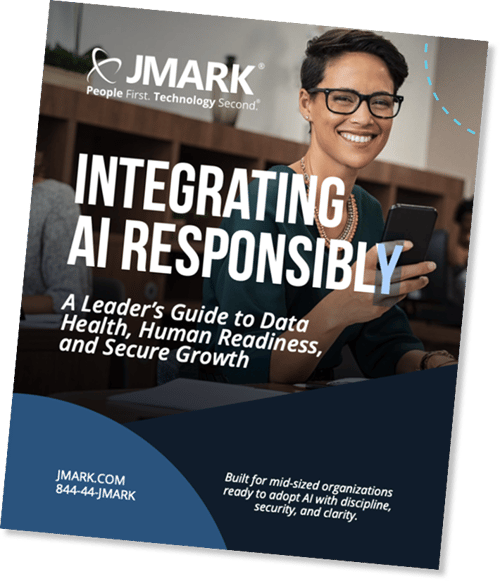
AI Leadership Guide
Before you implement AI, get this right.
Evaluate your data, security, and organizational readiness—so AI drives growth without introducing risk.
Case Studies
Nathan Petty, IT Officer
Scott Nield, CEO
Rakesh Gupta, VP of IT
Shawn Brown, Director of Shared Services